
No Asteroids Best Upgrades: What to Buy First
Ranked No Asteroids upgrades by payback: air tank, cargo, compactor, tether, laser and ship guns, with the prices we could confirm.
No Asteroids has five upgrade pools competing for one wallet: suit upgrades, ship systems, tools, ship guns and skills. The best purchase is never the most expensive card; it is the one that changes the next three shifts. This ranking is based on the prices and effects visible in the launch build and creator footage, not on a tier list of raw stats. The upgrade path→ turns it into a day-by-day order.
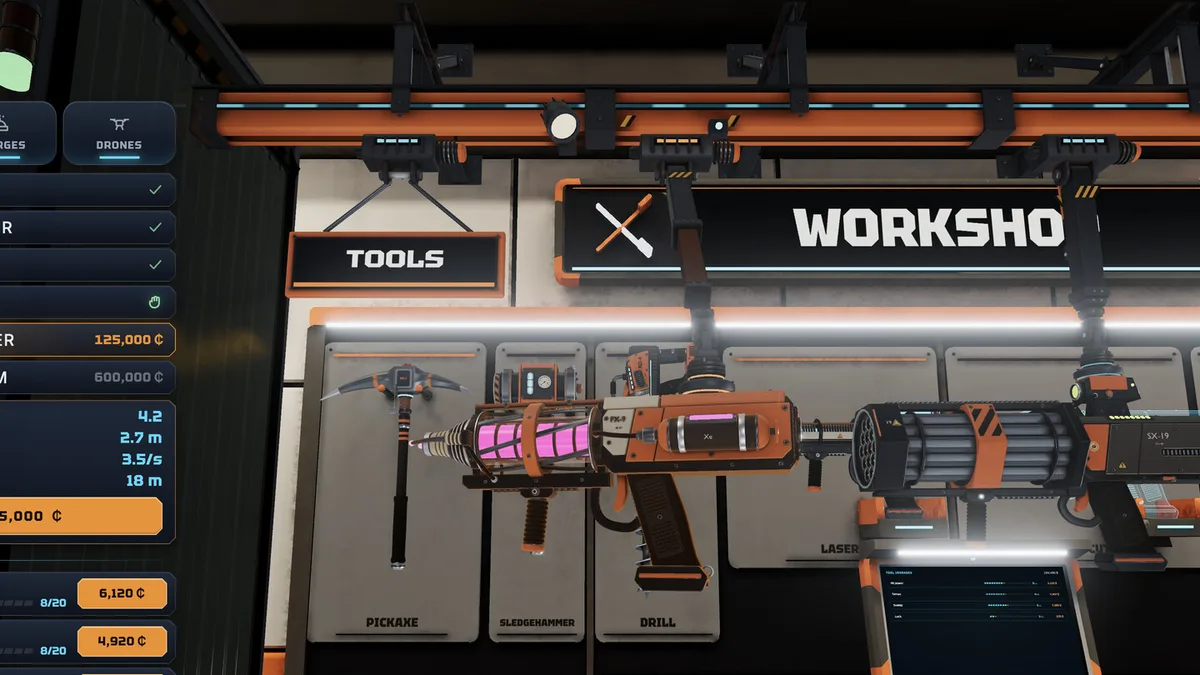
The ranking at a glance
| Rank | Upgrade | Known cost | Why it pays |
|---|---|---|---|
| 1 | Air tank | 60 for the second tier | More seconds per shift is more ore |
| 2 | Cargo hold | Varies | More units per trip, permanent |
| 3 | Compactor | Varies | +50% space, a direct income multiplier |
| 4 | Refining | 490 for rank 4 | +6% on every sale at rank 3 |
| 5 | Tether | Varies | Faster collection, less air spent |
| 6 | Laser drill | 42,000 | First tool that makes deep veins efficient |
| 7 | Boots / jetpack | Varies | Movement is air efficiency |
| 8 | Autocannon | 20,000 | First gun that actually breaks rock |
| 9 | Plasma cutter | 125,000 | Big damage and reach for the mid game |
| 10 | Collapsar | 1,200,000 | Endgame volume, not an early buy |
Why air and cargo come first
The opening tank is short, and the opening hold is small. Both constraints hit the same variable: how much ore reaches the terminal per unit of air. Adding 13 seconds or 50% capacity raises every future shift, including the ones you have not planned yet. A tool upgrade raises only the speed of cutting; if the hold fills before the vein breaks, the extra speed is wasted.
This is also why the movement upgrades rank above the first gun. The tether and boots reduce the time between the pod and the vein, which is the same as adding air. The gun creates chunks you still need capacity and time to collect.
The first real tool: laser at 42,000
The laser drill at 42,000 credits is the first purchase that changes the shape of a run. The pickaxe and sledgehammer are close-range; the laser cuts faster and reaches further, which means fewer repositioning loops and more combo uptime. Creator footage puts it at 42,000, and the demo can reach it within 15 days.
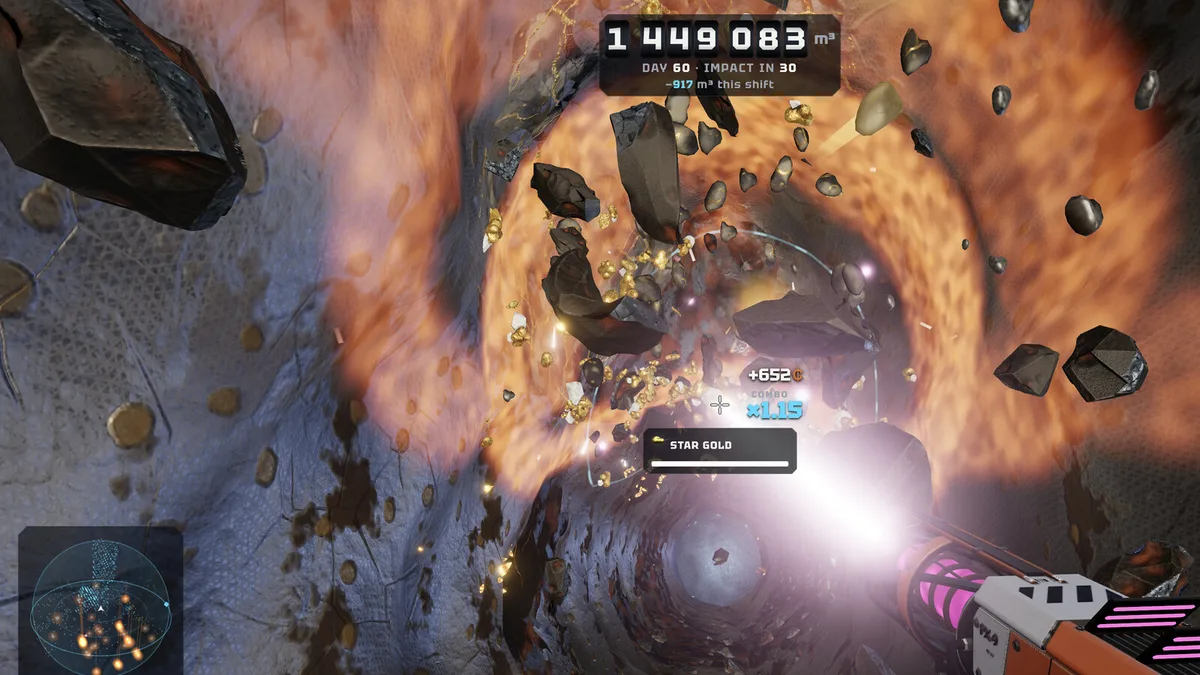
The plasma cutter at 125,000 is the next step, with a shop card showing damage 4.2, radius 2.7 m, rate 3.5 per second and reach 18 m. It is a mid-game tool, not a day-five purchase. The tools page→ lists all six with the confirmed prices.
Skills: the cheapest permanent gains
Refining rank 3 gives +6% ore price, and the next rank cost 490 credits in the capture. That is the best credits-to-percent ratio in the game. Buyers at 20,000 for +20% demand is a late-game skill; it only makes sense when your holds are already worth six figures.
Do not sleep on refining. A 6% raise on a 26,000-credit hold is about 1,560 credits, which pays back the 490 in the same shift.
Ship guns: when they become worth it
The turret at 1,250 is a slot filler. The autocannon at 20,000 is the first gun that meaningfully breaks rock, and the seismic cannon at 30,000 is the next step. Above that, the railgun at 100,000 and mass driver at 90,000 are mid-game, and the 250,000+ tier is for players who have already solved mining.
Guns matter because broken ore floats toward you; they are a second mining tool, not a combat system. That is why they rank below capacity and air. The ship guns page→ lists all nine prices.
What not to buy early
Cosmetics, museum displays and the telescope are content, not progress. The 1,250 turret is a trap because it feels like a ship upgrade without changing a shift. The 600,000 missile swarm is a late-game volume tool; buying it before the plasma cutter leaves you with a powerful tool and no capacity to use it.
Spreading 5,000 credits across three weak upgrades feels productive and leaves you with three weak systems. Buy one thing that changes tomorrow.
How the ranking changes in co-op
In co-op the host controls the wallet, so the group's first purchases should be shared infrastructure: cargo, compactor, air generator. A single player's tool upgrade only helps that player's swings, while a ship system helps all eight. The co-op guide→ covers the roles.
Frequently Asked Questions
What is the first upgrade to buy in No Asteroids? The first air tank, then the first cargo upgrade. Both raise every future shift.
Is the laser drill worth 42,000 credits? Yes. It is the first tool that makes deep veins efficient and is reachable inside the demo.
Should I buy ship guns before better tools? No. Guns create chunks; tools and capacity let you collect them. Buy the autocannon after the laser.
Is the compactor better than another cargo slot? The compactor is a 50% multiplier and usually the better early buy.
Sources
Official source: No Asteroids on Steam ↗ Official source: No Asteroids press page ↗ Tested source: Steam launch-build screenshots captured 2026-11-19 (workshop, tool stats and skill costs) Community source: No Asteroids Steam news hub ↗