
No Asteroids Mining Guide: Scan, Break, Haul, Repeat
How mining works in No Asteroids: scanner depth tags, vein health, combo multipliers, floating chunks, caves and the air budget per trip.
Mining in No Asteroids is not a matter of swinging harder. It is a route: pick a vein worth the air, cut it without resetting the combo, carry the chunks that actually pay, and get back before the pod leaves. The asteroid is 5,000,000 m³; your pickaxe removes a few cubic metres per swing. Everything else is efficiency. The ore prices page→ tells you which rock deserves the trip.
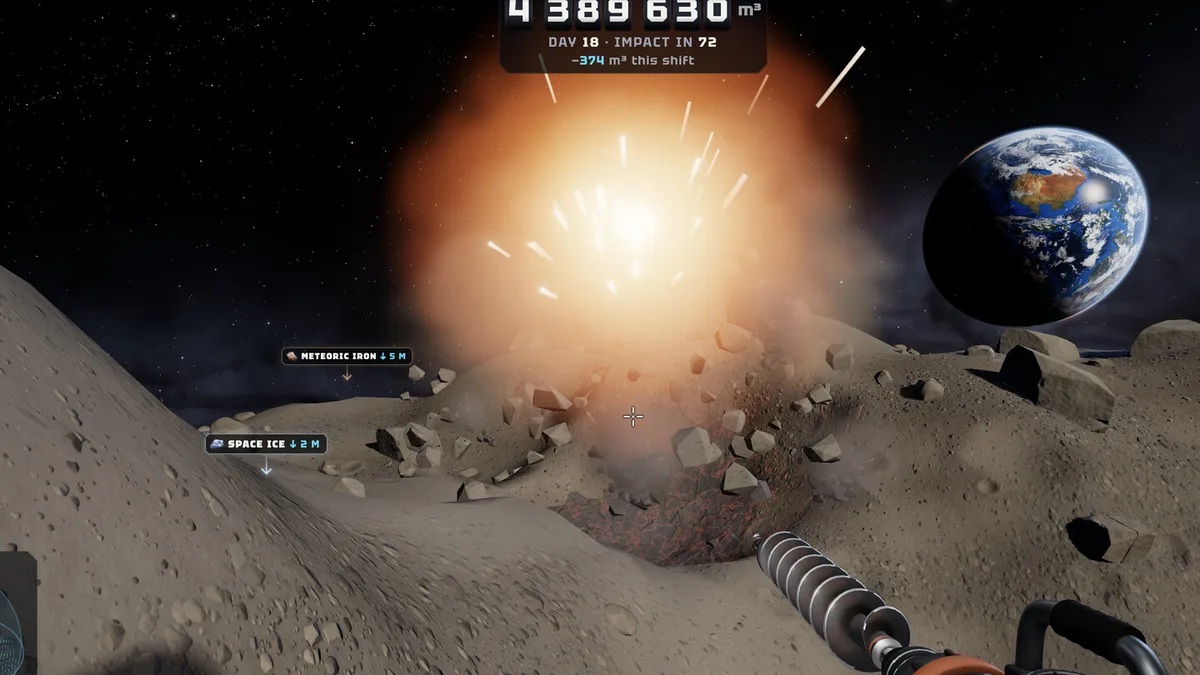
Scan before you land
The scanner is bound to C. It highlights ore through rock at about 25 m and prints a name with a depth arrow, such as METEORIC IRON ↓5 M or SPACE ICE ↓2 M. That arrow is the difference between a 30-second dig and a two-minute climb.
Scan from the surface and look for a cluster, not a single tag. A cluster of star gold or space crystal is worth landing for; a lone ice pocket is not. The scanner also works inside caves, which is how you find the vein you just heard cracking behind a wall.
Understand vein health and the combo
Ore sits in named veins with their own health bar. STAR GOLD and METEORIC IRON are the labels you will see most; each takes a number of hits and then breaks into floating chunks. A single hit shows a number (+297 on iron with the laser, +652 on a high-value hit with the plasma cutter).
Consecutive hits build a combo. The plasma cutter capture shows COMBO ×1.15, which multiplies the value of the hit. The practical rule: stay on one vein until it breaks. Repositioning, switching ore or stopping to fight the jetpack resets the chain and costs more than the extra swing.
The four-step loop
- Find the vein. Scanner, depth arrow, cluster.
- Cut it down. One target, steady hits, no target switching.
- Collect the chunks. Broken ore floats. Walk into it or use the tether to pull it in; big chunks can be stood on to reach higher veins.
- Leave at half air. The return trip is part of the run, not a formality.
The fourth step is where most runs fail. The air and oxygen page→ explains how to budget the timer, but the short version is: the lander distance readout is a cost, and a 150 m climb at 30 seconds of air is a lost hold.
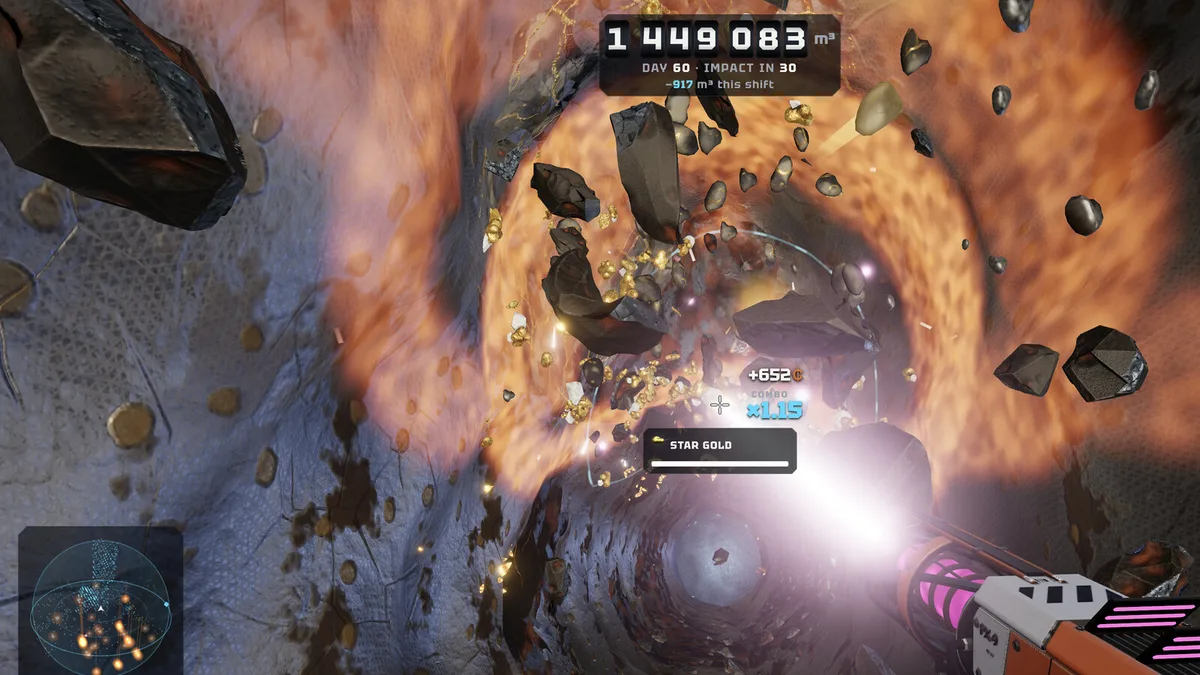
Caves, holes and the vertical problem
Drills and charges let you go into the rock, not just across it. A cave is the best and worst place to mine: the ore is concentrated, but the exit is a vertical climb and the air timer does not care about your route. Two habits help.
First, cut stairs. A series of small ledges lets you walk out instead of jetpacking. Second, never enter a cave with less than half air unless the vein is visible from the entrance. The jetpack meter is separate from air, but the time you spend hovering is air you are not spending on the return.
Meteor showers add a third hazard: falling rock can enter the hole you are digging. The meteor shower page→ covers the warning and the safe response.
What the ship guns actually do
Ship guns fire automatically at the asteroid while you are on a shift. They break rock loose, which means the ore floats toward you instead of waiting to be cut. That is the real value of the 20,000-credit autocannon and the 90,000-credit mass driver: not damage numbers, but free chunks.
The catch is that guns are a multiplier on a working loop. If your hold is small and your air is short, a gun just gives you more rock to leave behind. Buy the tools→ and suit upgrades first, then let the ship contribute.
Tool choice by ore
The six tools are a ladder, not a sidegrade. The pickaxe handles the opening; the sledgehammer is the iron answer; the drill, laser and plasma cutter cut faster and reach further; the missile swarm at 600,000 is a volume tool. The launch build lists the laser at 42,000 and the plasma cutter at 125,000, with damage, radius, rate and reach stats on the shop card.
The practical upgrade point is the laser. It is the first tool that makes a deep vein feel like a route instead of a project. The tools page→ has the full price ladder and the stats we could confirm.
Cargo discipline
A full hold is not the goal; a valuable full hold is. Space ice at 4¢ and meteoric iron at 6¢ are ballast compared with star gold at 13¢, space crystal at 22¢ and plasmite at 28¢. When the hold is nearly full, stop cutting ice and look for a better pocket. The cargo page→ covers capacity upgrades and the compactor.
Ore veins read as bright streaks in the rock. Chasing the glow keeps the combo alive; chewing the wall does not.
Frequently Asked Questions
How do I find ore in No Asteroids?
Press C to scan. Ore is highlighted through rock at about 25 m with a name and a depth arrow.
What does the combo multiplier do? It increases the value of consecutive hits on the same vein. Switching targets resets it, so finish the vein.
Can I stand on the broken rocks? Yes. Large chunks float and can be used as platforms to reach higher veins or climb out of a hole.
Do ship guns mine for me? They break rock loose automatically while you are on a shift. They help, but they do not replace a tool or a route.
Sources
Official source: No Asteroids on Steam ↗ Official source: No Asteroids press page ↗ Tested source: Steam launch-build screenshots captured 2026-11-19 (scanner, combo, cargo and tool states) Community source: No Asteroids Steam news hub ↗