
How to Make Money in No Asteroids: Credits and ROI
The fastest credit routes in No Asteroids: ore priorities, refining payback, daily orders, cargo discipline and when to stop saving.
Credits in No Asteroids come from one place: ore sold at the ship terminal. Everything else — the daily order, refining, the ship guns — is a multiplier on that sale. The fastest players are not the ones who swing the most; they are the ones who bring back the most valuable hold per minute of air. This page covers the credit side. The ore price table→ covers the raw numbers.
The three levers
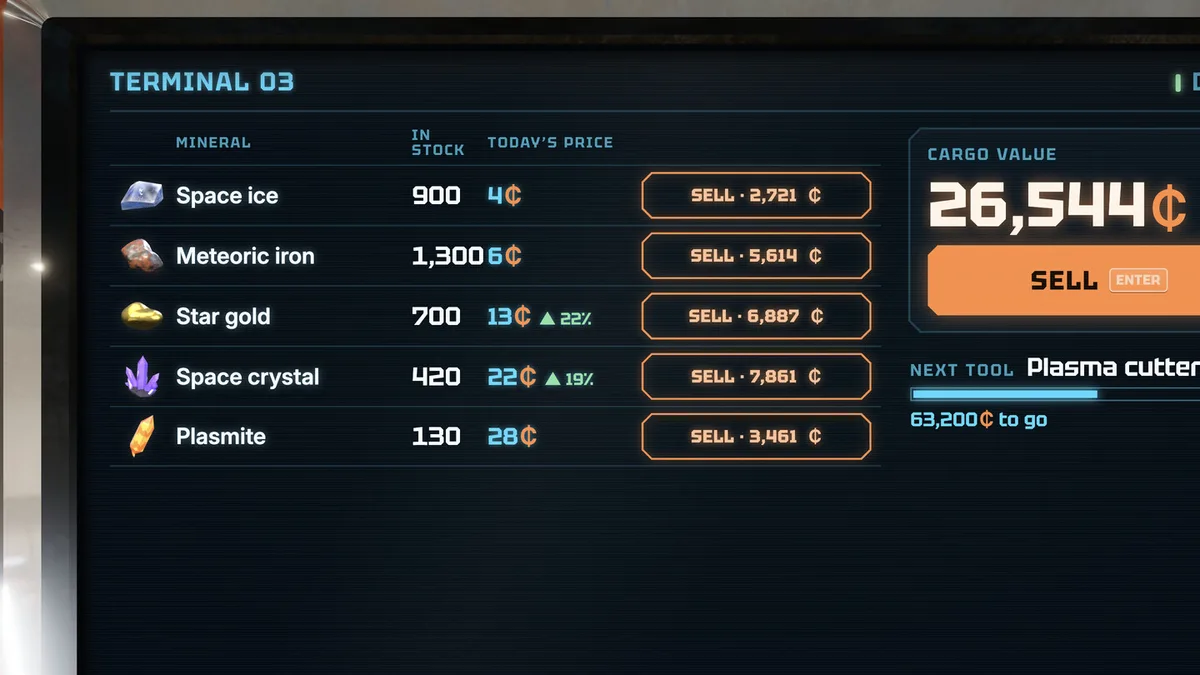
Value per unit. Plasmite 28¢, crystal 22¢, gold 13¢, iron 6¢, ice 4¢. The order is stable enough to plan around.
Units per hold. Cargo capacity upgrades and the compactor increase how much you bring back. A 50%-space compactor is a direct multiplier on every future sale.
Holds per day. Air, movement and distance decide how many trips you can make before the day rolls over. This is why the tether and jetpack are economy upgrades, not comfort upgrades.
Improve any one lever and income rises. Improve all three and the early game collapses into a few profitable days.
Sell the right rock
The biggest single mistake is a full hold of ice. At 4¢ per unit, ice is ballast; at 28¢, plasmite is the reason to land. When the hold is at 80%, stop cutting the cheap ore and scan for a better pocket. If the order demands ice, fill the order first, then top up with value.
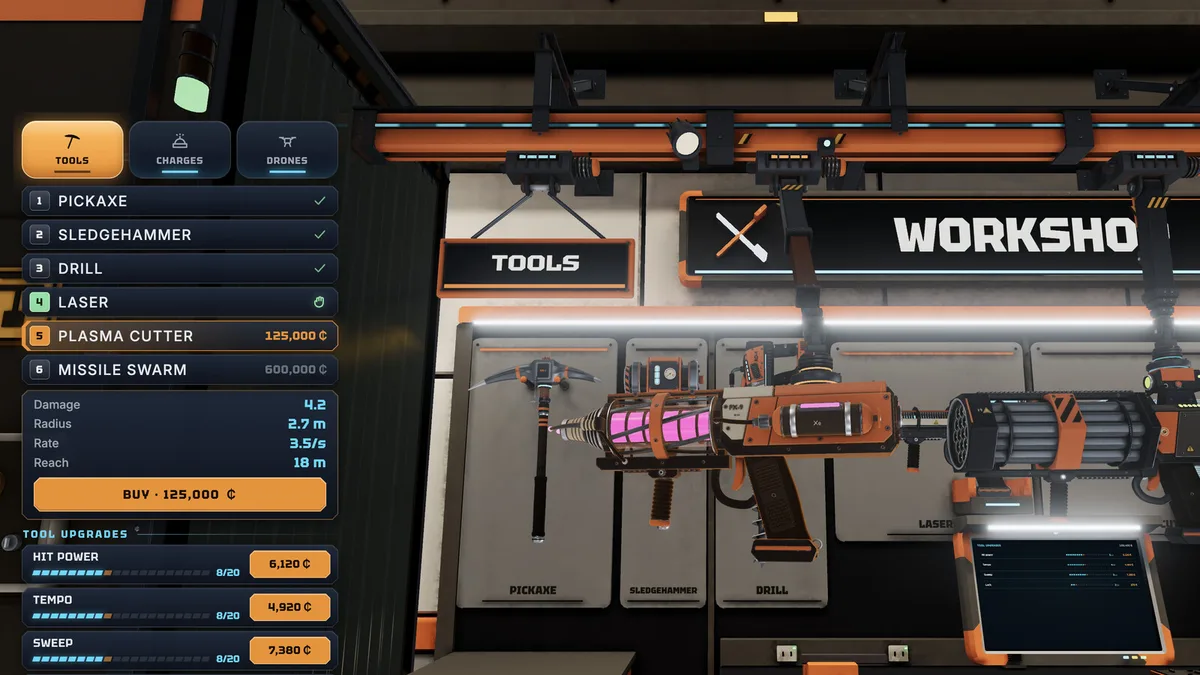
A mixed hold in the day-30 terminal capture was worth 26,544¢. That is roughly two-thirds of the 42,000¢ laser drill, or about a fifth of the 125,000¢ plasma cutter. Those ratios are the planning numbers: your next tool costs a certain number of good holds.
Refining is the cheapest permanent upgrade
Refining rank 3 gives +6% ore price, and the next rank costs 490¢ in the capture. A 6% raise on a 26,000¢ hold is about 1,560¢, so the skill pays for itself in less than one hold. Buy it early and never think about it again. Buyers, at 20,000¢ for +20% demand, is a late-game purchase for players already selling six-figure cargo.
The upgrade path→ places both skills against the tool and suit purchases that compete for the same credits.
Use the Order of the Day as a bonus, not a job
The daily order pays credits for ore you were going to dig anyway. A 100 m³ order is a warm-up; a 450 m³ order is a full shift; a 55-unit star gold order is a targeted run. Check it before you land, and only chase it when the requested ore is on your route. A failed order costs nothing, but the detour can cost air.
Do not lose the hold
The most expensive mistake in the game is missing the lander. Ten seconds after the countdown starts, the pod leaves; anyone outside passes out and loses their suit cargo. A 26,000¢ hold lost at the door is worse than a mediocre hold sold on time. The air page→ has the turn-around rules.
When to stop saving and buy
Buy when a purchase changes the next three runs. Air tank, cargo hold and compactor all do. A cosmetic does not. A ship gun does, but only after the mining loop is stable, because guns create chunks you still need capacity and air to collect.
The rough order that works: first air tank, first cargo upgrade, compactor, tether or boots, laser at 42,000, then ship guns in the 20,000–100,000 range. The best upgrades page→ ranks the whole list, and the ship guns page→ prices the weapons.
Co-op economics
In co-op every player's ore goes into one wallet, and the host decides who can spend it. That means the group's income is the sum of eight holds, but the spending decisions are centralized. A group that agrees on the next purchase before the session earns faster than a group that argues at the terminal. The wallet permissions page→ covers the mechanics.
A realistic credit curve
Days 1–5: thousands per hold, first air and cargo upgrades. Days 6–15: 10,000–30,000 per good hold, laser within reach. Days 16–30: ship guns start contributing, holds worth tens of thousands. Days 30+: six-figure upgrades become the norm, and the 1,200,000 Collapsar becomes a campaign goal rather than a fantasy. The 90-day math→ shows how the volume curve matches the credit curve.
The first Refining level costs 490 and adds 6% to every sale. A 42,000 laser takes dozens of shifts to pay back; Refining pays back in two.
Frequently Asked Questions
What is the fastest way to make credits in No Asteroids? Bring back high-value ore (plasmite, crystal, gold) in a large hold, sell it in one trip, and buy refining early for the permanent 6%.
Is the Order of the Day worth doing? Yes when the ore is on your route. It is a bonus, not a reason to cross the asteroid with low air.
Should I save for the Collapsar or buy mid-tier guns? Buy mid-tier guns first. A 1,200,000 credit gun is a campaign goal; a 20,000–100,000 gun changes the next twenty shifts.
Do credits carry into the second contract? Upgrades and progress carry into the 10,000,000 m³ contract after the main asteroid is cleared.
Sources
Official source: No Asteroids on Steam ↗ Official source: No Asteroids press page ↗ Tested source: Steam launch-build screenshots captured 2026-11-19 (terminal, cargo and workshop states) Community source: No Asteroids Steam news hub ↗